

AComprehensiveGuidetoAdaptiveSoftwareDevelopment
Adaptive Software Development (ASD) is a direct descendant of an earlier agile structure, Rapid Application Development (RAD). Furthermore, it attempts to help teams respond rapidly and efficiently to changing requirements or market needs by improving their products through lightweight management and continuous learning.
Adaptive Software Development (ASD) is a direct descendant of an earlier agile structure, Rapid Application Development (RAD). Furthermore, it attempts to help teams respond rapidly and efficiently to changing requirements or market needs by improving their products through lightweight management and continuous learning.
The ASD model promotes teams to develop in three stages: speculation, collaboration, and learning. Adaptive Software Development is a widely used software development paradigm based on continual learning and adaptation. It is based on the older Rapid Application Development (RAD) methodology and provides a flexible way to solve complicated business problems.
Background of Adaptive Software Development
In 1997, Jim Highsmith, a software industry expert, released his important book "Adaptive Software Development: A Collaborative Approach to Managing Complex Systems." This book established the ASD methodology and presented the concept of accepting variations and unpredictability in software development projects.
Furthermore, Highsmith's ideas were influenced by the burgeoning agile software development movement, which gained popularity in the late 1990s and early 2000s. The Agile Manifesto, published in 2001, has many parallels with ASD, including a focus on persons and relationships over processes and tools, as well as an embrace of change rather than a strict plan.
During the early 2000s, ASD gained traction as more software development teams and companies saw the advantages of taking a flexible and adaptive approach. Highsmith continues to improve and promote the ASD technique, writing more books and papers and leading seminars and training programs.
Advantages of Adaptive Software Development
Adaptive software development provides several benefits, making it an appealing option for software development teams and businesses.
By adopting flexibility, teamwork, and constant adaptation, ASD enables teams to develop high-quality software solutions that satisfy the changing needs of stakeholders and end users. Here are some of the major advantages of using an adaptive enterprise software development method:
Response to Changing Requirements
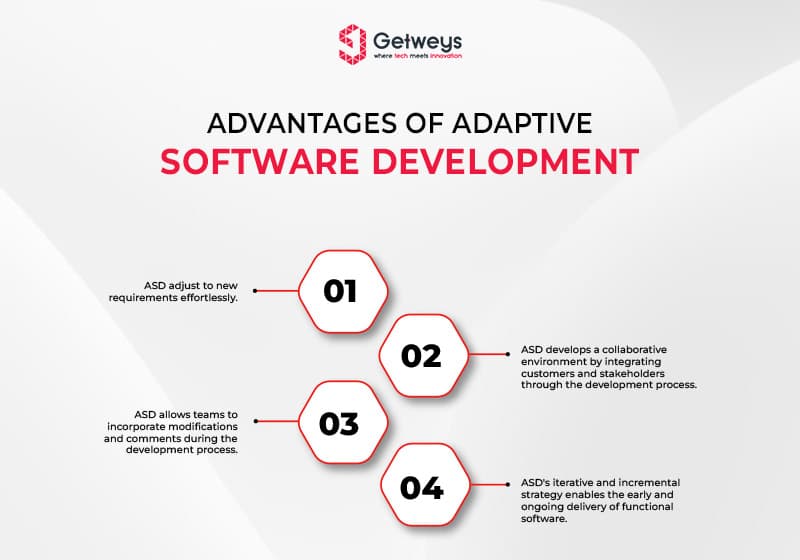
One of the key benefits of ASD is its ability to adjust to new requirements effortlessly. Traditional development approaches frequently struggle to adapt to new situations, resulting in delays, increased costs, and even project failures.
ASD allows teams to incorporate modifications and comments during the development process, ensuring that the final product meets the evolving needs of the stakeholders.
Increased Client Satisfaction
ASD develops a collaborative environment by integrating customers and stakeholders through the development process, including their views and contributions constantly.
This iterative method guarantees that the product being built matches their expectations, resulting in increased satisfaction among consumers and a more positive overall experience.
Shorter Time to Market
ASD's iterative and incremental strategy enables the early and ongoing delivery of functional software. Instead of waiting for the full project to be completed, stakeholders can begin using and offering input on the software in its early stages.
This shortens the time-to-market and allows businesses to capitalize on market possibilities faster.
Adaptive Software Development Life Cycle
Adaptive software development, like the rest of the technical industry, follows a cyclical evolutionary approach. It consists of three phases: speculation, collaboration, and learning. By following each process, you may tailor your code to the story twist.
Speculation Phase
Don't we all wonder about our larger purpose in life? That is what you should do at this phase. Speculate about the requirement for a code or application development. Determine the end purpose of your business program.
When it comes to adaptive software, unpredictability is a major consideration. Planning might be highly constraining for you; you require something that can easily adjust to your changing needs.
Collaboration Phase
This is the most important phase of adaptive software product development. When adopting this strategy to develop your program, keep an open mind. You must create a dynamic and organically constructive software solution. It must be able to adapt to complex and ever-changing conditions.
Collaboration is when you get down as a group to think through challenges, examine data, and uncover opportunities. Once there is shared information, your team may construct the solution. Collaboration is the foundation of this software development technique.
Learning Phase
To achieve the greatest results, important cross-functional teams must be formed and communication routes defined. You must also plan your communication techniques for the optimum outcome.
During the Learning Phase, you perform an internal review to better understand your customers. Nothing in software is complete unless you understand your people, teams, and end users. To adapt to the changing market, your team must undertake customer research, review the project's specifications, and learn about technology.
Difficulties in Adaptive Software Development
Here are some common difficulties faced during adaptive software development:
Takes Longer Time
This method of project planning takes longer than others. You may encounter a complex roadmap that is challenging to implement. Furthermore, you have to deal with unpredictability, which in itself is a significant hurdle.
High Resource Consumption
It can consume a lot of your resources. You may not have enough in-house, therefore you must outsource or employ extra. This appears to be a spending region for you. Beware! Think about it before you choose it.
Resistive to Change
It can be resistive to change. You may need to get ready your team and everyone on it for the shift before proceeding with it.
Conclusion
Each project and organization has distinct needs, limits, and team dynamics. Organizations must carefully evaluate their particular needs and consider implementing a hybrid approach, which combines aspects from many approaches to create a customized process that best meets their objectives.
To summarize, adaptive software development provides a compelling approach to software development, allowing teams to negotiate uncertainty, mitigate risks, and create high-quality software solutions that satisfy the ever-changing needs of stakeholders and end users. By embracing ASD principles and cultivating a culture of continuous learning and improvement, businesses can position themselves for success in the dynamic and ever-changing world of software development.
Written by the Getweys studio — Austin, Karachi, Auckland.